
The No-Arms-Overhead Blow Out:How to Get Gorgeous Hair When Life Has Other Plans
How to blowout your hair when you have limited mobility and can't lift your arms above your head.
SELF CAREBEAUTYHAIRSTYLESURGERY RECOVERY
Chandra Chriswisser
4/25/20268 min read
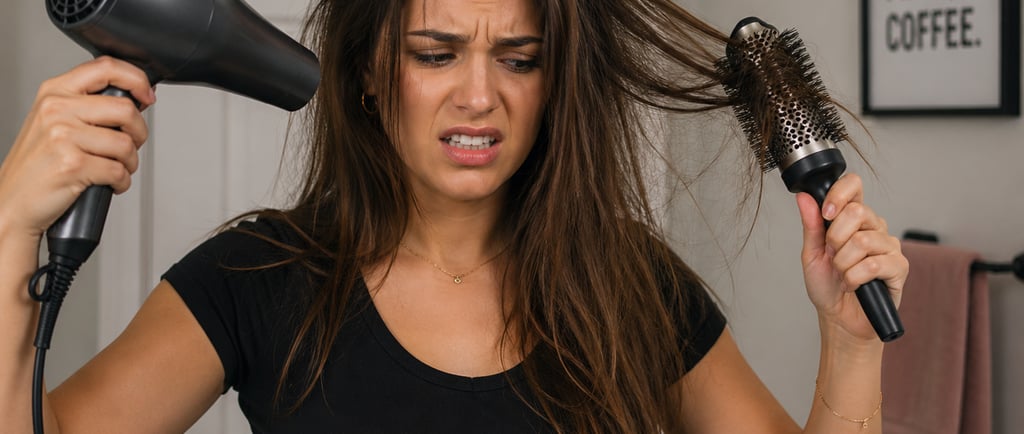
Let me set the scene for you.
It's week two after my spinal fusion surgery. I'm on the couch in a fog of pain medication, wearing the same oversized tee for the third day in a row, and my curly, wavy, gloriously unruly hair has officially staged a full-on rebellion. We're talking frizz that defies gravity. Volume that no one asked for. And not the good kind.
I felt like garbage — and my hair looked like it too.
Here's the thing: I'm a firm believer that when you look good, you feel better. Not because appearance is everything, but because taking care of yourself — even in small ways — sends a powerful message to your brain and your heart: I still matter. I'm still here. I'm going to get through this.
But with a spinal fusion, I physically could not lift my arms above my head for six weeks. Zero. Nope. Not happening. And if you've ever tried to blow out curly, frizzy hair without raising your arms… well, good luck, honey.
So I figured it out. I tested it on my couch, slowly, painfully, and with a lot of trial and error. And today I'm sharing the entire method — plus the exact tools that made it possible — so you don't have to reinvent the wheel when you're already running on empty.
🎬 Watch the Full Tutorial Video Here: https://youtu.be/ZWaWZq6ox1M
First, Let's Talk About Why This Is Even Hard
You might be wondering: why can't you just blow dry your hair normally? And the answer is: try it without raising your elbows above your shoulders. Go ahead, try. I'll wait.
Yeah. Exactly.
The truth is, standard blow drying relies heavily on overhead motion — holding the dryer up and directing airflow down the hair shaft while brushing or diffusing. When you lose that range of motion, the whole routine falls apart.
Who This Affects (You're Not Alone!)
Lifting the arms overhead seems like such a simple thing — until you can't do it. There are so many reasons this becomes temporarily (or even long-term) impossible:
Spinal Fusion Surgery — Like me! After spinal fusion, surgeons restrict patients from lifting their arms overhead during the healing process to protect the fusion site, the delicate hardware holding everything together, and the surrounding nerves and muscles. Even cervical (neck) fusion patients experience significant arm and shoulder weakness from nerve involvement.
Rotator Cuff Repair — One of the most common shoulder surgeries, rotator cuff repair requires the arm to be immobilized for four to six weeks. The rotator cuff muscles and tendons are literally what allow you to lift your arm above your head, so until they heal, up is not an option.
Shoulder Impingement or Bursitis — Chronic inflammation in the shoulder joint can make overhead movement excruciating, even without surgery.
Frozen Shoulder (Adhesive Capsulitis) — A condition where the shoulder joint becomes stiff and restricted, often making it impossible to lift the arm even partially.
Rheumatoid Arthritis or Joint Conditions — Inflammatory joint conditions can severely limit range of motion, particularly during flares.
Mastectomy or Breast Reconstruction Recovery — These surgeries affect the chest, shoulder, and underarm area, making overhead movement restricted and painful.
General Post-Surgical Recovery — Any surgery that affects the upper body, chest, or spine can create temporary limitations.
The bottom line: millions of women are navigating this exact challenge at any given time. And just because your arms won't cooperate doesn't mean your hair has to suffer.
Why Bothering With Your Hair Actually Matters for Your Mental Health
I know what you might be thinking. "Chandra, I just had surgery. Who cares about my hair?"
Hear me out. Because the science on this is actually kind of amazing.
The "Look Good, Feel Good" Effect Is Real
Researchers have a term for it: enclothed cognition. It's the scientific concept that describes how what we wear — and by extension, how we present ourselves — directly affects our mood, our mindset, and even our cognitive performance. A 2012 study from Northwestern University found that the simple act of getting dressed and putting yourself together creates a measurable psychological shift. Your brain literally responds differently.
Psychology Today has noted that quality self-care — including grooming and beauty rituals — is linked to enhanced self-esteem and self-worth, increased optimism, a more positive outlook on life, and lower levels of anxiety and depression.
When you feel positive about the way you look, research shows you tend to have higher levels of self-confidence, reduced stress, and a more optimistic outlook — even when things are hard. Even when you're recovering. Even when you feel like crap.
It's Also About Reclaiming Control
One of the most emotionally difficult parts of recovery is the loss of control. You can't do the things you normally do. You rely on other people. Your body isn't cooperating. Everything feels out of your hands.
Doing your hair — even in a modified way — is an act of agency. It's you saying: I get to decide how I show up today. That psychological shift is powerful, and it's something I felt deeply during my own recovery.
Grooming and self-care rituals reinforce a sense of self-worth and control, especially in challenging times. They're not frivolous — they're restorative.
The Tools That Make It Possible
Before we get into the technique, let's talk gear — because the right tools are everything here. When you can't move your arms overhead, you need a blow dryer that does more of the work for you.
The Blow Dryer
You need a dryer that is:
Lightweight — heavy dryers will fatigue your arms fast, especially in recovery
Powerful enough to dry efficiently at lower angles
Equipped with attachments that you need to smooth out that frizzy hair
Easy to hold with a neutral wrist position
Easy to use with one hand
I discovered this Shark blow dryer and gave it a try I was blown away by how good this thing actually worked and how easy it was to tame my unruly mop.
Here is the link to the blow dryer I swear by and used throughout my entire recovery make sure to check out the video link at the top of this post for an in-depth tutorial:
🔗 CLICK HERE TO CHECK OUT THE BLOWDRYER
The Products
Great products are your secret weapon when your technique is limited. These are the ones I used:
Keune Long & Strong Super Serum
Non-negotiable. This has been a huge part of my recovery ensuring that I did not lose much hair after anesthesia also protecting my scalp from heat styling. Keune Care Long & Strong Super Serum stimulates and strengthens with its cutting-edge formula designed to support healthier, fuller-looking hair from the root.
🔗 CLICK HERE TO LEARN MORE ABOUT THE SUPER SERUM
Keune Long & Strong Leave In
After surgery your hair can get really brittle and weak. Keune Care Long & Strong Densifying Leave-in Treatment boosts the look of volume and strength with its targeted formula designed to energize the scalp, fortify the hair fiber, and visibly increase hair density over time while also providing heat protection.
🔗 CLICK TO LEARN MORE ABOUT DENSIFYING LEAVE IN
Keune Royal Tribute Oil Serum
This I cannot live without it smooths, softens, add shine, and smells amazing!!
🔗 CLICK HERE TO LEARN MORE ABOUT ROYAL TRIBUTE SERUM
The Step-by-Step: How to Blow Out Curly/Frizzy Hair Without Lifting Your Arms
⚠️ Important: Always follow your doctor's specific post-surgical restrictions. This tutorial is designed to work within limited range of motion — but check with your provider if you have any concerns about movement during your recovery.
Step 1: Set Up Your Space (This Is Everything)
Ergonomics are going to be your best friend. Here's how to set yourself up for success:
Sit in a sturdy chair — not your couch. You want to be able to lean forward slightly without strain.
Place a small table or have a counter beside you at elbow height to rest your blow dryer hand when you need a break.
If possible, do this in front of a mirror — even a vanity mirror propped on a table works perfectly.
Have all your products already opened and within arm's reach.
Step 2: Prep Your Hair
Start with damp (not soaking wet) hair. Towel dry gently by squeezing — no rubbing, which creates frizz. Then:
Apply your products throughout your hair and comb through.
Step 3: Section Your Hair (The Lazy Girl Way)
You don't need perfect sections. You just need to work in manageable chunks. Using the blow dryer with the round brush attachment push the hair to one side and start by working in the back moving to the sides.
Step 4: The Low-Angle Blow Dry Technique
Here's the key: instead of holding the dryer UP and working down, you're going to let gravity and positioning do the work.
For the Bottom Sections:
Lean your head slightly to the side or forward (whatever your doctor allows).
Use the round brush to smooth and roll each section.
Roll the round brush toward your face and angle downward keeping your elbows low and near your side.
The key is directing airflow along the hair shaft — even from a lower angle, this smooths the cuticle and reduces frizz.
For the Top and Crown:
Grab the top section setting on the brush and rolling it forwards toward your face.
Tip your head forward — chin toward chest — and let the hair fall forward.
For the Sides:
Tilt your head to one side and let that section fall naturally.
Hold the dryer on the opposite side at chest height, directing airflow down the hair.
Switch sides.
Step 5: Finish and Set
Once your hair is dry:
Apply a small amount of finishing serum or oil to your palms and smooth over the surface — just your hands, just from the front. No overhead required.
Brush the serum through if needed
Quick Tips & Modifications
Rest often. There's no shame in taking a break mid-blowout. Set the dryer down, breathe, and continue when ready.
Dry shampoo is your recovery BFF. On days when even this technique feels like too much, dry shampoo at the roots buys you an extra day and adds volume.
A silk or satin pillowcase helps keep your style fresher longer, meaning you're doing this less often.
A loose braid or bun at night protects your blow out and reduces frizz without requiring overhead styling.
Ask for help with the back if you have someone home. There's no medal for doing it all solo. Let someone else hold the dryer on the back sections — that's what people who love you are for.
Watch the Full Video Tutorial
Words can only go so far — which is why I filmed the entire process so you can see exactly how this works in real time. I filmed this during my own recovery, because I wanted you to see it's really possible even on the hard days.
🎬 Watch the Tutorial: CLICK HERE FOR FULL TUTORIAL
A Final Note From Chandra
Here's what I want you to take away from all of this: taking care of yourself when you feel your worst isn't vanity. It's self-compassion. It's resilience. It's you showing up for yourself on the days when showing up feels impossible.
I did my hair on days I couldn't get off the couch without help. Not because I had to. But because it made me feel like me again. And feeling like me gave me the strength to keep healing.
You deserve that too. In every season of life — the easy ones and the ones that break you open.
Now go get gorgeous. You've got this. 💕
— Chandra, Sip & Self Care
Shop the Post
(Add all your affiliate links below in one convenient place for readers)
🔗 LONG & STRONG DENSIFYING LEAVE IN
#SipAndSelfCare #RecoveryHair #BlowDryTips #CurlyHairTips #SurgeryRecovery #SpinalFusion #SelfCareWhenItIsHard #FrizzyHairHelp #CurlyHairRoutine #WellnessBeauty
Disclosure: This post contains affiliate links. If you purchase through my links, I may earn a small commission at no extra cost to you. I only share products I truly love and use myself. Thank you for supporting Sip & Self Care! ♥
© Sip & Self Care | sipandselfcare.com